
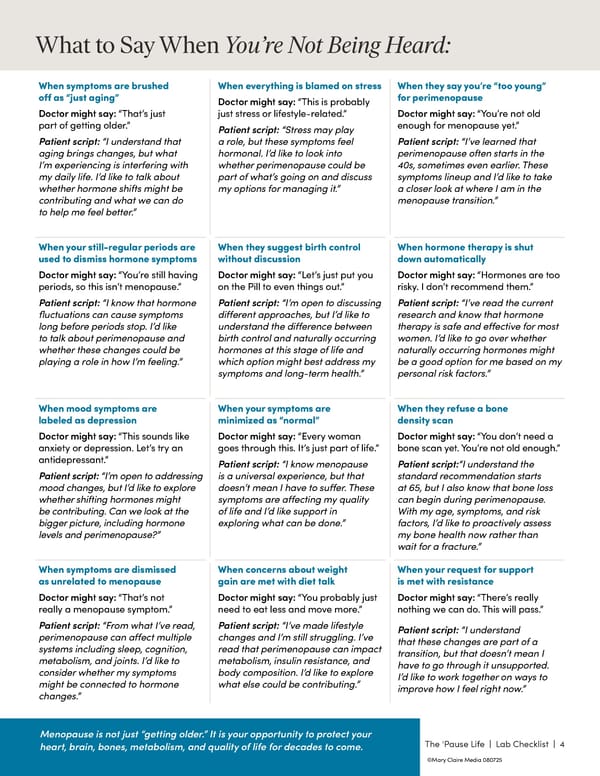
The 'Pause Life | Lab Checklist | 4 What to Say When You’re Not Being Heard: When symptoms are brushed off as “just aging” Doctor might say: “That’s just part of getting older.” Patient script: “I understand that aging brings changes, but what I’m experiencing is interfering with my daily life. I’d like to talk about whether hormone shifts might be contributing and what we can do to help me feel better.” When everything is blamed on stress Doctor might say: “This is probably just stress or lifestyle-related.” Patient script: “Stress may play a role, but these symptoms feel hormonal. I’d like to look into whether perimenopause could be part of what’s going on and discuss my options for managing it.” When they say you’re “too young” for perimenopause Doctor might say: “You’re not old enough for menopause yet.” Patient script: “I’ve learned that perimenopause often starts in the 40s, sometimes even earlier. These symptoms lineup and I’d like to take a closer look at where I am in the menopause transition.” When your still-regular periods are used to dismiss hormone symptoms Doctor might say: “You’re still having periods, so this isn’t menopause.” Patient script: “I know that hormone fluctuations can cause symptoms long before periods stop. I’d like to talk about perimenopause and whether these changes could be playing a role in how I’m feeling.” When they suggest birth control without discussion Doctor might say: “Let’s just put you on the Pill to even things out.” Patient script: “I’m open to discussing different approaches, but I’d like to understand the difference between birth control and naturally occurring hormones at this stage of life and which option might best address my symptoms and long-term health.” When hormone therapy is shut down automatically Doctor might say: “Hormones are too risky. I don’t recommend them.” Patient script: “I’ve read the current research and know that hormone therapy is safe and effective for most women. I’d like to go over whether naturally occurring hormones might be a good option for me based on my personal risk factors.” When mood symptoms are labeled as depression Doctor might say: “This sounds like anxiety or depression. Let’s try an antidepressant.” Patient script: “I’m open to addressing mood changes, but I’d like to explore whether shifting hormones might be contributing. Can we look at the bigger picture, including hormone levels and perimenopause?” When your symptoms are minimized as “normal” Doctor might say: “Every woman goes through this. It’s just part of life.” Patient script: “I know menopause is a universal experience, but that doesn’t mean I have to suffer. These symptoms are affecting my quality of life and I’d like support in exploring what can be done.” When they refuse a bone density scan Doctor might say: “You don’t need a bone scan yet. You’re not old enough.” Patient script:“I understand the standard recommendation starts at 65, but I also know that bone loss can begin during perimenopause. With my age, symptoms, and risk factors, I’d like to proactively assess my bone health now rather than wait for a fracture.” When symptoms are dismissed as unrelated to menopause Doctor might say: “That’s not really a menopause symptom.” Patient script: “From what I’ve read, perimenopause can affect multiple systems including sleep, cognition, metabolism, and joints. I’d like to consider whether my symptoms might be connected to hormone changes.” When concerns about weight gain are met with diet talk Doctor might say: “You probably just need to eat less and move more.” Patient script: “I’ve made lifestyle changes and I’m still struggling. I’ve read that perimenopause can impact metabolism, insulin resistance, and body composition. I’d like to explore what else could be contributing.” When your request for support is met with resistance Doctor might say: “There’s really nothing we can do. This will pass.” Patient script: “I understand that these changes are part of a transition, but that doesn’t mean I have to go through it unsupported. I’d like to work together on ways to improve how I feel right now.” Menopause is not just “getting older.” It is your opportunity to protect your heart, brain, bones, metabolism, and quality of life for decades to come. ©Mary Claire Media 080725
 The 'Pause Life: Lab Checklist Page 3