
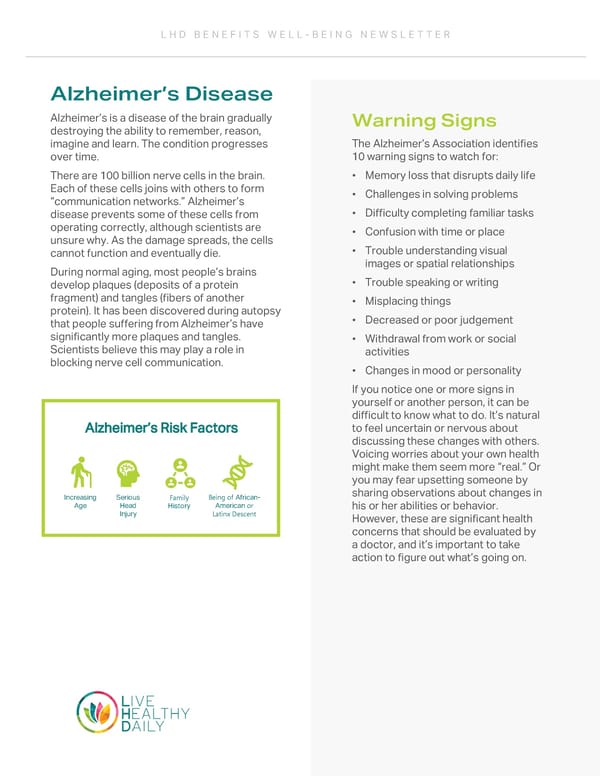
L H D B E N E F I T S W E L L - B E I N G N E W S L E T T E R Alzheimer’s Disease Alzheimer’s is a disease of the brain gradually destroying the ability to remember, reason, imagine and learn. The condition progresses over time. There are 100 billion nerve cells in the brain. Each of these cells joins with others to form “communication networks.” Alzheimer’s disease prevents some of these cells from operating correctly, although scientists are unsure why. As the damage spreads, the cells cannot function and eventually die. During normal aging, most people’s brains develop plaques (deposits of a protein fragment) and tangles (fibers of another protein). It has been discovered during autopsy that people suffering from Alzheimer’s have significantly more plaques and tangles. Scientists believe this may play a role in blocking nerve cell communication. Warning Signs The Alzheimer’s Association identifies 10 warning signs to watch for: • Memory loss that disrupts daily life • Challenges in solving problems • Difficulty completing familiar tasks • Confusion with time or place • Trouble understanding visual images or spatial relationships • Trouble speaking or writing • Misplacing things • Decreased or poor judgement • Withdrawal from work or social activities • Changes in mood or personality If you notice one or more signs in yourself or another person, it can be difficult to know what to do. It’s natural to feel uncertain or nervous about discussing these changes with others. Voicing worries about your own health might make them seem more “real.” Or you may fear upsetting someone by sharing observations about changes in his or her abilities or behavior. However, these are significant health concerns that should be evaluated by a doctor, and it’s important to take action to figure out what’s going on. Alzheimer’s Risk Factors Increasing Age Serious Head Injury Being of African- American or Latinx Descent Family History
 Tips for Better Brain Health Page 1